
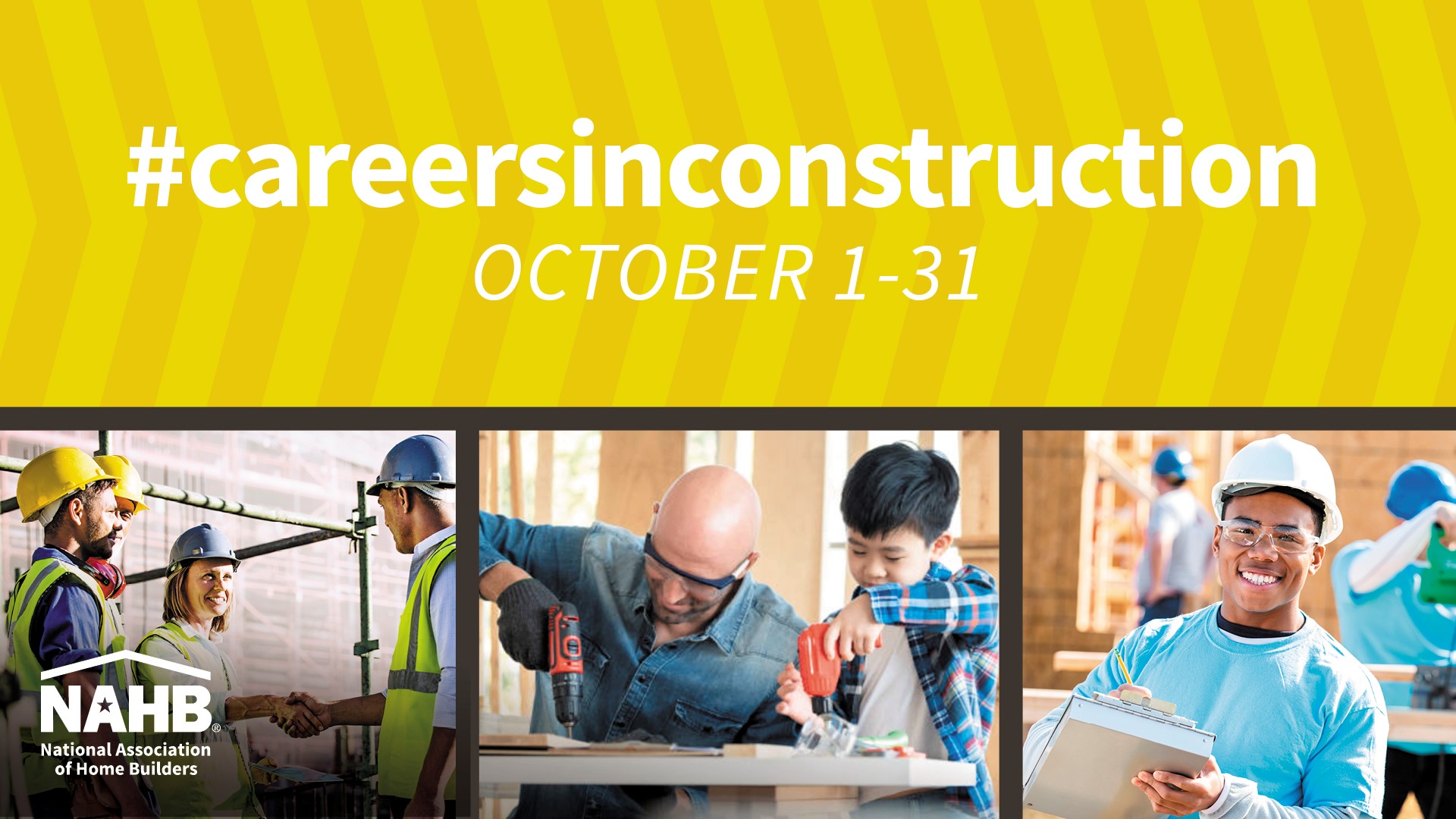
NAHB Kicks Off Careers in Construction Month
NAHB is celebrating and raising awareness of the fulfilling and lucrative construction careers in our annual Careers in Construction Month.
October’s slate of events will focus on student chapter engagement, mentorship and inspiring the next generation of industry professionals.
Careers in Construction Month events include:
Oct. 1-3: Careers in Construction Month Kickoff
Share how you are celebrating careers in construction with another member or executive officer at the Fall Leadership Meeting.
Oct. 7-11: Engage with Boys & Girls Clubs
Make a connection with your local Boys & Girls club to prepare kids for career readiness and the various career paths required to build and sell homes.
Oct. 14-18: Student Chapter Engagement
Reach out to your affiliated student chapters to see how you can support students studying construction this school year. See some examples from other HBA leaders.
Oct. 21-25: Young Professionals Week
YP Week connects Young Professionals in the building industry nationwide, with a focus on mentoring, community involvement and professional development. Check out this year’s programming.
Oct. 25: Careers in Construction Day
Student Chapters, HBAs and industry members are encouraged to organize and participate in a community service building project. Learn more.
Oct. 28-31: Celebrate Residential Construction
Share on social media how you celebrated the construction industry. Examples include posting pictures or videos at your job or sharing a message about a mentor or teacher who impacted your career path.
Members are encouraged to promote the Careers in Construction Month flyer and Facebook cover banner. Student Chapter logos are also available.
Learn more in the Careers in Construction Month toolkit.

Latest from NAHBNow
Economics
Oct 27, 2026
Affordability Challenges Push New Home Sales Lower
Sales of newly built single-family homes decreased 0.6% in September to a seasonally adjusted annual rate of 676,000, following a downwardly revised August estimate, according to newly released data from the U.S. Department of Housing and Urban Development and the U.S. Census Bureau. The pace of new home sales was 5.3% lower than a year earlier.
Economics | Workforce Development
Oct 26, 2026
How Old Are America's Construction Workers?
NAHB analysis takes a deeper look into the median ages of construction workers by state and by trade.
Latest Economic News
Economics
Oct 26, 2026
Uptick for Non-Conventional Financing in 2025
Nationwide, the share of non-conventional financing for new home sales accounted for 32.4% of the market, according to NAHB analysis of the 2025 Census Bureau Survey of Construction (SOC) data.
Economics
Oct 23, 2026
A Quarter of Remodelers Started ADUs Over Past Twelve Months
When asked if remodelers started a project involving an Accessory Dwelling Unit (ADU) over the past twelve months, 24% indicated that they were building an addition for use as an ADU and 23% indicated that they were converting an existing space to an ADU, according to NAHB’s Remodeling Market Index (RMI).
Economics
Oct 23, 2026
Slabs Overtake Basements in the East North Central Division
Nearly three-quarters of new single-family homes started in 2025 were built on slab foundations, according to NAHB analysis of the U.S. Census Bureau’s Survey of Construction (SOC).