
Upcoming Changes to Efficiency Standards for AC Units and Heat Pumps
On Jan. 1, 2023, new minimum efficiency standards for air conditioners and heat pumps will go into effect across the United States.
Federal standards for equipment efficiencies are implemented by the U.S. Department of Energy (DOE) in accordance with the Energy Policy and Conservation Act (EPCA) of 1975. This is the first time since 2015 DOE is updating air conditioner and heat pump efficiency standards.
All new units will be required to meet the updated standards. Home builders and HVAC contractors should be getting ready for the transition as equipment meeting older standards will be phased out.
For the Southeast and Southwest regions (see map below), the Jan. 1, 2023 deadline will also apply to the installation of air conditioning systems at the building. Because the indoor and outdoor units must be paired to achieve the rated system efficiency, but can be installed at different stages of construction, it’s important that HVAC contractors and builders plan accordingly to meet the January 1 installation deadline. The installation deadline applies only to the AC units (not to heat pumps and not to other specialty systems). The installation deadline does not apply to the North region for any equipment.
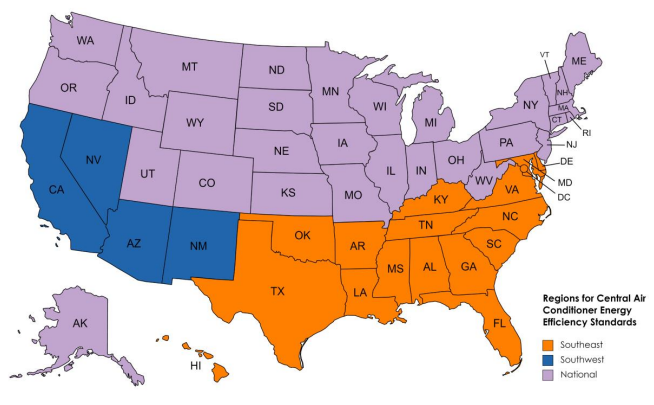
Source: Air-Conditioning, Heating, and Refrigeration Institute
In addition, the metrics used to designate systems’ efficiencies will change to reflect updates to the underlying testing protocols. The new efficiency designations will be referred to as SEER2 and EER2, replacing the outgoing SEER and EER designations. With the simultaneous changes to efficiencies and designations, home builders are encouraged to work closely with their equipment suppliers to ensure a smooth transition.
Key developments to know:
Split systems air conditioners: The minimum efficiency regional standards for split system air conditioners will change based on the geographical location and system capacity:
| North Region | |||
| System capacity | Outgoing minimum efficiency | New minimum efficiency | |
| New Metric | Corresponding outgoing metric | ||
| AC (all capacities) | 13.0 SEER | 13.4 SEER2 | 14.0 SEER |
| South Region | |||
| System capacity | Outgoing minimum efficiency | New minimum efficiency | |
| New Metric | Corresponding outgoing metric | ||
| AC (< 45 kBtuh) | 14.0 SEER | 14.3 SEER2 | 15.0 SEER |
| AC (45-65 kBtuh)1 | 14.0 SEER | 13.8 SEER2 | 14.5 SEER |
| Southwest Region | |||
| System capacity | Outgoing minimum efficiency | New minimum efficiency | |
| New Metric | Corresponding outgoing metric | ||
| AC (< 45 kBtuh) | 14.0 SEER | 14.3 SEER2 | 15.0 SEER |
| 12.2 EER | 11.7/9.8 EER22 | 12.2/10.2 EER2 | |
| AC (45-65 kBtuh)1 | 14.0 SEER | 13.8 SEER2 | 14.5 SEER |
| 11.7 EER | 11.2/9.8 EER22 | 11.7/10.2 EER2 | |
Notes:
- A 3.5-ton system will fall below the 45 kBtuh threshold whereas a 4-ton system will exceed it.
- Contact your HVAC supplier for details where the lower rating applies.
Split System Heat Pumps: The minimum efficiency of split system heat pumps will increase uniformly throughout the country:
| Outgoing minimum efficiency | New minimum efficiency | |
| New Metric | Corresponding outgoing metric | |
| 8.2 HSPF / 14 SEER | 7.5 HSPF2 / 14.3 SEER2 | 8.8 HSPF / 15.0 SEER |
Single Package AC systems: The minimum efficiency of single package heat pumps will remain the same, but the new designations of HSPF2 and SEER2 will apply:
| Outgoing minimum efficiency | New minimum efficiency | |
| New Metric | Corresponding outgoing metric | |
| 8.0 HSPF / 14 SEER | 6.7 HSPF2 / 13.4 SEER2 | 8.0 HSPF / 14.0 SEER (no change) |
The installation deadlines for air conditioning systems in the Southeast and Southwest regions will require additional planning and coordination between HVAC designers, HVAC contractors, equipment manufacturers, and home builders. Existing stock of single and two-stage split system AC units tagged using the outgoing SEER and HSPF rating will be allowed after January 1, 2023 deadline provided that the FTC label meets the 2023 efficiency standard. For example, a 3.5-ton AC unit labeled as 15 SEER will be allowed. To verify if the condensing unit is compliant, check the SEER and region on the FTC label.
The regulation defines installation of a central air conditioner as the connection of the refrigerant lines and/or electrical systems to make the central air conditioner operational.
The new efficiency standards do not affect furnaces or water heaters.
For additional details on energy standards that govern equipment efficiencies, refer to the Code of Federal Regulations.
Latest from NAHBNow
Trends
Oct 07, 2026
Share of Homes With Two-Story Foyers Increases For First Time Since 2022
For the first time since 2022, the share of new homes with two-story foyers increased, according to the Census Bureau's Survey of Construction (SOC). Despite the increase, the market share of two-story foyers has generally trended downward since 2017, with most new single-family homes being built without a two-story foyer both nationally and regionally.
Economics
Oct 07, 2026
Mortgage Rates Continued to Rise in September
Mortgage rates rose sharply in September as multiple factors applied significant upward pressure on U.S. treasury bond yields, a key factor in mortgage rates.
Latest Economic News
Economics
Oct 07, 2026
ARM Share Increased as Mortgage Rates Spiked
Mortgage application activity declined as the 30-year fixed mortgage rate rose sharply. The Mortgage Bankers Association’s (MBA) Market Composite Index, a measure of total mortgage application volume, decreased 7.7% month-over-month in September on a seasonally adjusted basis. Compared to a year ago, total mortgage applications were lower by 35.4%.
Economics
Oct 06, 2026
Mortgage Rates Rise as Treasury Yields Top 5%
Mortgage rates rose sharply in September as multiple factors applied significant upward pressure on the U.S. treasury yields. According to Freddie Mac, the 30-year fixed-rate mortgage averaged 6.86% in September, up nearly 20 basis points (bps) from August.
Economics
Oct 05, 2026
Two-Story Foyer Share Edges Up in 2025
In 2025, around a quarter of new homes were built with a two-story foyer, slightly up from 2024, according to data obtained from the Census Bureau’s Survey of Construction (SOC) and tabulated by NAHB.