
What Is the Most Common Siding Material for Single-Family Homes?
According to the annual data from the Census Bureau’s Survey of Construction (SOC), stucco was the most common principal siding material (26.8%) for new single-family homes started in 2023. Other common materials include:
- Vinyl siding (25.6%),
- Fiber cement siding (21.7%), and
- Brick or brick veneer (18.5%).
Small shares of single-family homes started last year had wood or wood products (5.1%) and stone, rock or other stone materials (1.2%) as the principal exterior wall material.

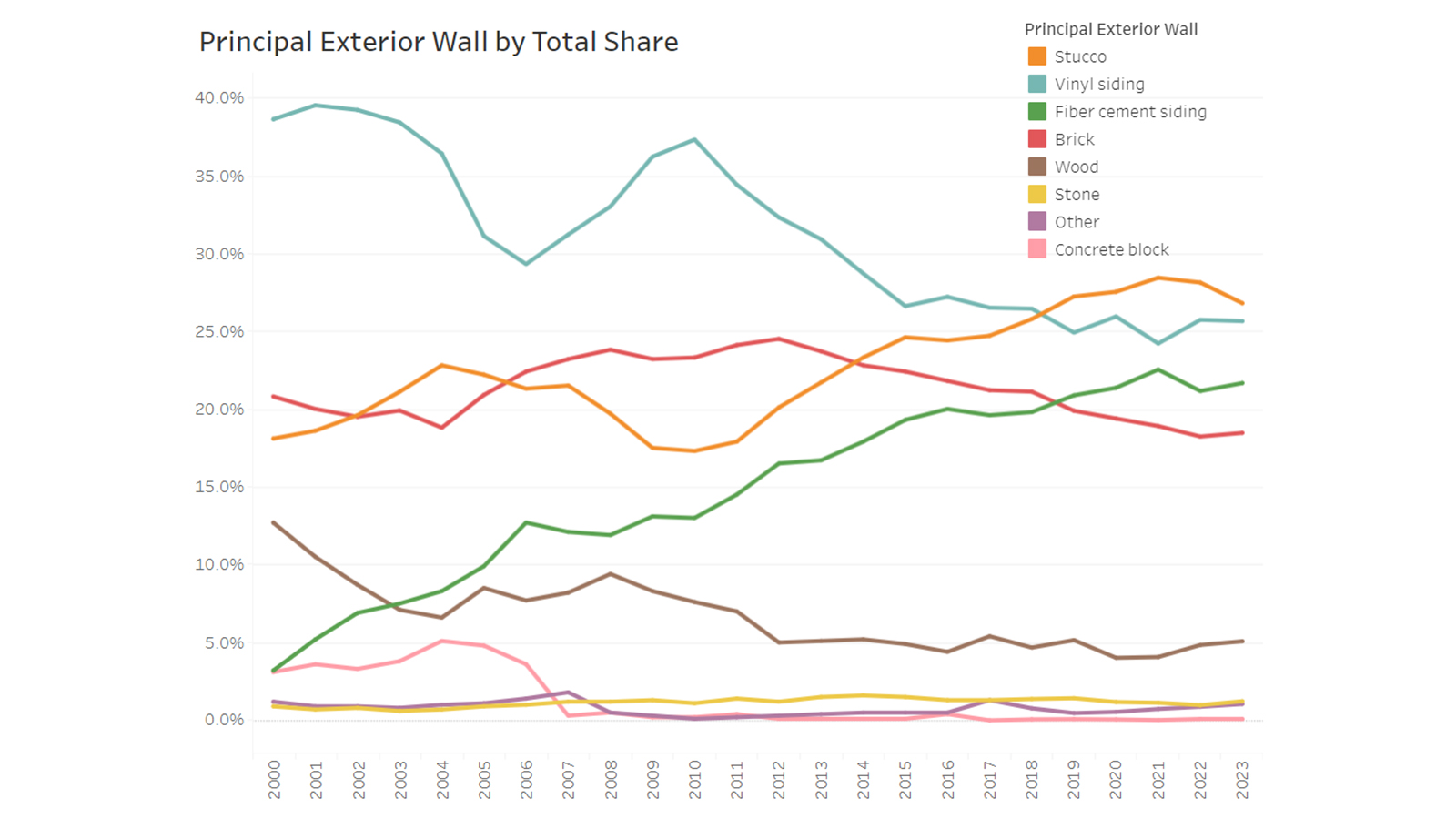
Since NAHB began tracking this data in 2000, the strongest trend has been the growing popularity in fiber cement siding. The share of fiber cement siding has increased by five percentage points in the last 10 years and is up by 14.2 percentage points in the past 20 years.
Another major trend is the decline of vinyl siding. Although it has remained steady in recent years, the share has dropped 5.3 percentage points in the last 10 years and 12.8 percentage points in the last 20 years.
Stucco has also been relatively flat in recent years but has seen an overall incline since 2000. After a low in 2010 of 17.3%, its share has risen almost 10 percentage points in 2023.
Onnah Dereski, NAHB manager of economic services, highlights which exterior siding materials are most common in each of the nine U.S. Census divisions in this Eye on Housing post.
Latest from NAHBNow
Advocacy
Oct 23, 2026
Trump Issues Executive Order to Lower Housing Costs
President Trump on Oct. 22 signed an executive order to lower single-family and mortgage costs, and the Treasury Department released new institutional investor rules.
Advocacy
Oct 23, 2026
NAHB Commends President Trump’s Executive Order on Housing
NAHB Chairman Bill Owens issued the following statement today regarding President Trump’s housing executive order.
Latest Economic News
Economics
Oct 22, 2026
Share of New Homes with Decks Inches Upward
The share of new homes with decks inched upward, from an all-time low of 17.4% in 2024 to 17.8% in 2025, according to NAHB tabulation of data from the HUD/Census Bureau Survey of Construction (SOC).
Economics
Oct 22, 2026
State-Level Employment Situation: September 2026
State-level employment data for September continued to show a mixed labor market, with job gains and losses split across the county. Although national nonfarm payroll employment increased modestly, year-over-year job growth varied considerably across states
Economics
Oct 21, 2026
Nearly One in Three Construction Workers are Hispanic
Diversifying the construction labor force remains a key priority amid persistent skilled labor shortages. According to NAHB analysis of the 2024 American Community Survey, non-Hispanic White workers account for the majority of the construction industry at 55.8%. Hispanic workers now represent nearly one-third of the labor force at 32.8%, followed by non-Hispanic Black workers at 5% and non-Hispanic Asian workers at 1.8 %.